Blog
Healthcare Spotlight: Raising Awareness on International Day of Sign Languages
24 Sep 2025

International Day of Sign Languages, observed each year on 23rd September, is a time to celebrate the rights of deaf people and promote greater awareness of the languages and communication methods that many rely on every day.
In the UK, more than 70,000 people use British Sign Language (BSL) as their first language1, but BSL isn’t the only form of communication used by people who are deaf or hard of hearing. Families also use Sign Supported English, Makaton, and AAC (augmentative and alternative communication) devices to help children and adults connect with the world around them.
At Tree of Hope, we work with families of children with hearing loss and deafness to raise funds for medical treatment, therapies, and specialist support. By shining a light on International Day of Sign Languages, we want to highlight the experiences of families raising deaf children and encourage those in need to reach out for support.
Understanding Types of Hearing Loss in Children
Children can experience different levels of hearing loss, and recognising the signs early can make a huge difference. The main types of deafness are2:
- Mild hearing loss – Able to hear speech in a quiet room but struggles in noisy places or with whispers.
- Moderate hearing loss – Can hear louder sounds, like a baby crying, but finds it difficult to follow speech in noisy environments.
- Severe hearing loss – Unable to hear speech without aids such as hearing aids or cochlear implants but may hear some loud sounds like dogs barking.
- Profound hearing loss – Cannot hear speech without aids but may sense very loud noises or vibrations.
- Total deafness – No hearing at all, though vibrations from sounds may be felt.
An audiologist can confirm your child’s level of hearing loss through a hearing test and audiogram.
Signs Your Child May Have Hearing Loss
Some children are born deaf, while others develop hearing loss later in childhood. If you’re concerned about your child’s hearing, watch out for these early signs2:
- Babies with red ears or pulling at their ears
- Watching faces and lips closely
- Speech and language delays, or mispronouncing words
- Talking louder or softer than expected
- Not responding to sounds or appearing inattentive
- Wanting the TV or music volume turned up higher
- Difficulty following conversations in noisy environments
If you notice these symptoms, it’s important to seek medical advice. Early diagnosis can help your child access the right support, including hearing aids, cochlear implants, or communication methods such as British Sign Language.
A Family Story - Love for Lyra: Smiles to Steps
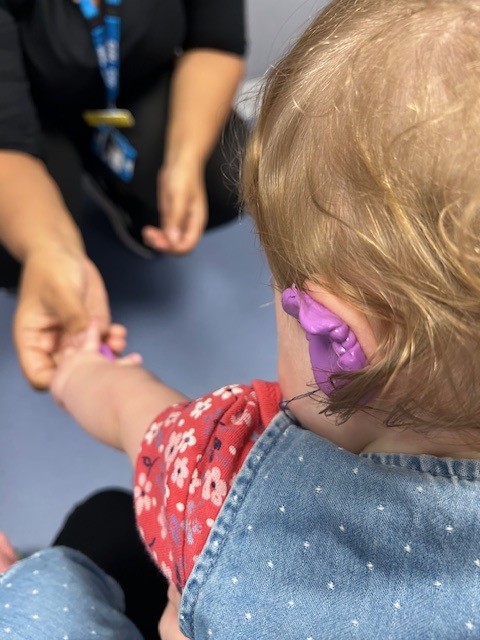
At Tree of Hope, we’re privileged to support families like Hayley Hubbard’s, who is mum to 14-month-old Lyra. Lyra was diagnosed with profound hearing loss and Cerebral Palsy following complications at birth.
Despite passing an early hearing test, it became clear to Hayley that Lyra wasn’t responding to sounds. After further assessments, Hayley and her family received confirmation of Lyra’s profound deafness “which means she has no level of hearing whatsoever, like she’s never heard sound. But it’s a really unusual type, because her ears work fine, it’s just her brain can’t understand the sound at the auditory nerve, so it’s somewhere in her brain that’s stopping her from hearing sound.”
Juggling Work, Family Life, and a Child with Additional Needs
For many parents of children with hearing loss or additional needs, the return to work after maternity leave can feel overwhelming. Balancing childcare, employment, and multiple medical appointments becomes part of daily life.
Hayley share that “alongside the audiology appointments, Lyra also has occupational therapy, physio, dietician and ophthalmologists as well, so there’s many different services to juggle in.” This is on top of caring for her unwell husband, supporting her eldest daughter as she starts primary school, helping Lyra settle into nursery, and managing her own return to work.
Specialist Support for Deaf Children
Starting nursery has been a big step for Lyra, giving her the chance to connect with her peers and develop her communication skills. For children with profound hearing loss, having the right support in early education makes a huge difference, and for Lyra, she has struck gold with her nursery setting, as Hayley explains that “Lyra has a British Sign Language (BSL) level six teacher, which is very rare to have in a nursery setting. She’s signing all the time to Lyra in the class, so actually it’s very beneficial for all the other children as well. They’ve been coming home and doing signs, they have things like sign of the week so that parents can also learn different signs, but [the nursery] are learning through us as well.”
The nursery also receives guidance from Lyra’s teacher of the deaf to help create an inclusive learning environment, giving them tips about the lighting in the room, reducing background noise, and making sure that the teachers engage in eye contact with Lyra when communicating.
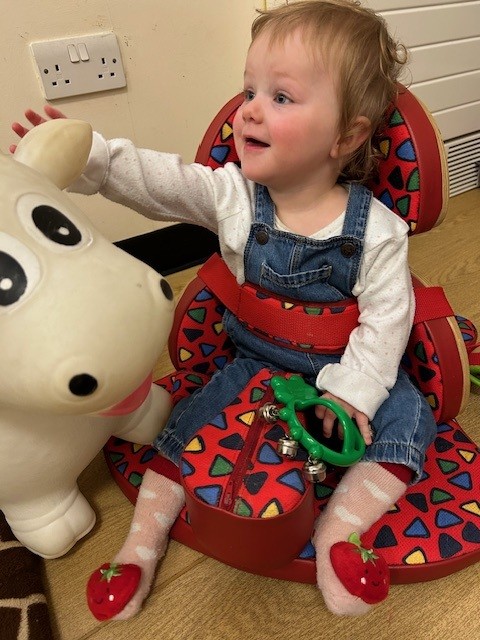
Here is Lyra communicating about Cows with her teacher, whilst reaching out for a Cow toy!
Challenges of Using Sign Language with Additional Needs
For children who are profoundly deaf, British Sign Language (BSL) is often the most effective way to communicate. However, for families where a child has additional conditions such as Cerebral Palsy, using sign language can present unique challenges due to limited mobility.
For Lyra, the motion in her hands is limited, which makes it difficult to understand what she is attempting to sign, so her family are actively exploring other alternative communication methods and adapting their daily routines to support her preferred ways of expressing herself. For Hayley, this means that “what we tend to do is we have a drink in one hand, food in the other hand and she will reach out for the things she wants and smiles at that item, so then we bring it closer and if she still then looks like she wants that item that's her telling us that that’s what she wanted.”
Whilst this works at home, a lack of awareness within the community can be a challenge for families like Hayley’s as “people just assume I’m doing Makaton, or that I’m just doing the baby signs from going to a baby signing class, and she doesn’t have hearing aids, so if people are talking to her and she’s not looking at you, she won’t know anything’s happening and it might seem like she's not engaging, but actually if she's looking [at you] and she knows about it, she'll be smiling and really engage with it.”
Acceptance and Understanding of Different Forms of Communication
For people with hearing loss or deafness, acceptance and understanding of different ways of communicating is key to building a more inclusive and accessible society. There are many ways that children and adults who are deaf may choose to communicate, including:
- British Sign Language (BSL)
- Makaton
- Supported signing and lip reading
- AAC (augmentative and alternative communication) devices
Some people may also use hearing aids or cochlear implants, but even with these, certain sounds and frequencies can remain difficult to hear. This means that communication often needs to be adapted to each individual.
Understanding signs can often be a lot simpler than you might realise. Hayley emphasises that “quite often [signing] is just what you would expect it to be. For example, asking ‘how are you’ can literally be responded to with a thumbs up or down, and ‘hello’ is a simple wave and simply needs to be a more visual conversation.”
Learning British Sign Language (BSL)
For parents raising a child who is deaf, learning British Sign Language (BSL) can be an empowering way to strengthen communication and connection. Hayley has recently returned to BSL classes with Heathlands School after first attempting to learn during lockdown. Hayley says that "It's level 1 and classroom based. So far I've been using Sign Supported English (SSE) at home, which means I sign and speak at the same time. I do this so Lyra's older sister, Maeve can understand what I'm saying, but the course is teaching me the correct order of words for BSL."
For families and individuals who want to start learning sign language, it’s important to know that you don’t always need to attend formal classes. There are many free online BSL resources that can help you learn basic signs to support communication with deaf children and adults. For example, Commanding Hands offers free online courses, videos, and resources to help more people gain confidence in using BSL.
Take a look at this simple video and learn for yourself some basic phrases and words, to help create a more inclusive society.
Learning Sign Language Resources
Want to Learn Sign Language? Here are some resources to get you started:
- Online British Sign Language Course - Learn BSL Today
- Similar to Duolingo = Download a language app with Lingvano
- Watch some signed stories with your children with Leanne Signed Stories
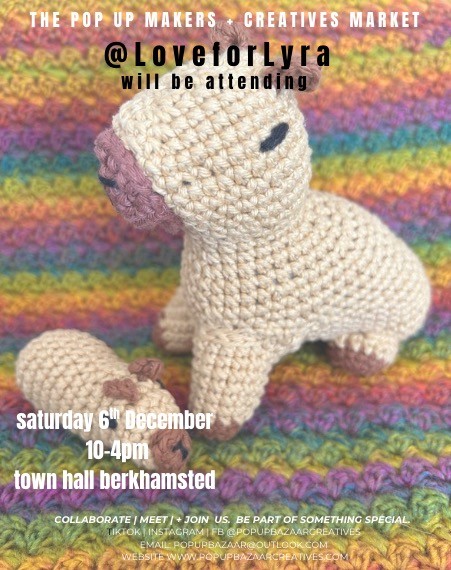
To support Lyra's journey, take a look here or if you're local to Hertfordshire, head to Berkhamsted Town Hall on either 6th December (10-4pm) or 21st December (10-3pm) for some crochet Christmas decoration, hair accessories and flowers with proceeds going to Lyra's campaign